My trek starts with irritatingly loud drilling by some construction guys across the street. Normally, I would cringe, and possibly cover my ears, but for this exercise, I decided to stop and listen. Eerily, as I stopped walking, so does the drilling. I hear them talking to each other, but I'm far away enough not to make out anything decipherable. I decide to cross 2nd avenue, and head west. As I wait for the light, I notice the M15 driving past me, and I hear a loud wooosh, like a turbo on a racecar. I've never noticed that before.
I hear 2 dogs barking at each other across the street and they stop and one walks over for a buttsniff. I hear an ambulance or police car too far away for me to actually see, and actually, physically closing my eyes for a few seconds, I can hear more than one siren! With so many people around me, it's strange that I can't hear their voices clearly. The sounds of cars, trucks, and buses drown out everything else. I cross 2nd avenue slowly and I actually hear the sirens getting louder, but it's a type of siren you don't normally hear in the city. I look back and see that the siren is coming from a group of black cars donning diplomatic plates, and they're blazing through the bike lane- these are the guys from the UN summit. I wonder if I can ride on the bike lane later tonight when I head downtown.
As I approach Lexington Ave, I can actually begin to put words to the sounds I hear as there are infinitely more people scattered all over the street scrambling for their lunches at 2pm. There's a ton more traffic here and I hear Spanish music pouring out of a beat up Lincoln Navigator that's seen better days. I can hear a woman somewhere behind me talking to her child, telling her something about being such a great girl for doing something in school. I turn around and see that she is talking into her phone. I also noticed an M57 crossing 57th Street, but the bus did not make the same woosh sound as the M15.
I decide to walk uptown on Park and I hear a familiar sound, the sound only my car makes. I drive a Subaru WRX and the engine makes a very specific exhaust note that all Subaru WRXs make. I nod to the driver as he comes to a stop and he nods back - it's something we do in the WRX "brotherhood". Even though I wasn't driving, we just have this kind of sixth sense that we can spot other WRX owners easily. In the "brotherhood", we take our nodding seriously, and if we both happened to be driving, and I didn't nod to him first, or didn't catch his nod and consequently not nod back, it'd be blasphemous. Not that there's a secret WRX nod-police patrolling our streets, but that I would simply suffer with the thought of knowing that I ignored a fellow brother on the road. It's more serious than it sounds.
Monday, September 26, 2011

Tuesday, May 31, 2011
Children of Hope


 The documentary style filming also highlighted the sense of urgency, as a lot of times, I found myself alertly searching the background for a bomb or soldier, and I also found myself ducking during some scenes. I also found the single shot style more engaging and lifelike, rather than the traditionally multi-shots. Actually, thinking back now, there was a very long scene that was shot in one take, I think the scene where Julianne Moore is killed when they are ambushed. I know this is extremely difficult to do in one take, and it gives it a very realistic sense of time and continuity. The scene where the baby’s cries momentarily stops the war is eerily hopeful, and had a very spiritual and religious tone to it, but when the fighting continued in a split second, it tells us a great deal of humanity and of the tension that truly fuels our desires to kill rather than to live. However, I REALLY liked the ending - perhaps the "incompleteness" of the cut and not truly knowing whether or not civilization had been saved is what is needed to fuel the hope required to necessitate that desire to live.
Tuesday, May 24, 2011

Wednesday, April 6, 2011
The museum is where?

Having assumed that all museums were discreetly nestled sporadically thoughout the city, I'd originally envisioned my bike ride there filled with more uncomfortable moments with cabbies and buses than the pleasant tranquility that actually ensued.
After a few minutes with google earth, I had my trek meticulously planned. I made sure to pack some extra PB&J sandwiches and plenty of H2O in case the fixed-gear ride over the 59th St. Bridge warranted a boost in energy or morale.


I cross the bridge with relative ease and am warmly welcomed by the locals in Long Island City. This sign told me so.....................................
Along the way, I noticed some colorful murals that needed attention therefore I got down with the king and snapped a few shots...


After the pleasant ride, I reached the museum and found a meter in front of a Starbucks to lock up my baby. Once inside the museum, we quickly learned about the history of film. It got its start in the 1820's as an optical illusion toy called the Filmatrobe a.k.a The Spinning Wonder. The illusion is created with two pictures back to back, one of a bird, and the other of an empty cage. When rapid vertical spinning is applied, the illusion is that the bird is in the cage.
This paved the way for the Zoetrobe, which had a similar principle, except that the rotation is horizontal, and the "flickering" is achieved with intermittent black spaces, producing the "Running Man" (no relation to the 1987 Arnold "flick"). A cooler, three-dimensional Zobascopic zoetrobe was created to satisfy zoetrobe enthusiasts and the effect was achieved with a strobe light.
Fast Forward 60 years, and Edward Muybridge accidentally stumbles upon a more awesome illusion by putting many still photographs of a horse galloping together to create a string of pictures giving the illusion of the horse in motion.
This "flipbook" technique was demonstrated by entering a video camera that prompted the subject (or subjects as is this case in which I and 3 other classmates volunteered) to move around in 3 second intervals to simulate a flipbook capture of stills. The result was as much fun to watch as it was to record!

 The flipbook phenomenon introduced the Motuscope to the world, and people everywhere were able to enjoy short "movies" by rotating a rather heavy handle clockwise. Sounds like too much work? It was. So people invented the three scope film, which was used with the technacolor camera to record television programs that people all over the world were able to enjoy in the comfort of their homes. I Love Lucy was one of the first widely "recorded" programs that sparked a revolution in the business. Besides breaking racial boundaries, it used the three camera set up and a first ever live studio audience.
As we enter the voice-over room, we are asked to pick from a list of movies. Having never seen Babe, I decided to pick this wonderful film and do a bit of voice over magic. I rehearsed the line once, and then carefully followed the screen to record my voice into the microphone. I gave it a good effort, but failed to adequately capture the despair in Babe's voice. I learned to really appreciate the difficulty in the timing and "acting" of the seemingly simple job of voice-overs. This gives me a new appreciation for cartoons, and validates (perhaps) the exorbitant amount of money celebrities are paid to contribute their voices to epic films like Toy Story and Ice Age.

Moving onto the visual-enhancing room, we learn about all the components that go into enhancing the aesthetic quality of a movie. The famous example of the scene in The Exorcist where the little girl spins her head (an image I thought I'd successfully blocked from memory until I was reminded of it today) shows us that animatronics and puppets can achieve the sort of stunning visual effects that would not be possible with human actors. When combined, CG and animatronics creates a much more engaging viewing experience than with traditional props. Additionally, by using CG, we're protecting real human actors when a scene that portrays a dangerous situation is needed.

 Other than the fresh image of the little girl spinning her head, I learned from this trip that a myriad of components and key people go into making a movie. From silent "flickering" films, to black and white with sound, and to movies today that combine wonderuflly orchestrated sound to accompany stunning visual images, film-making has definitely come a long way. The aesthetic quality of a movie, while important, can never undermine the deeper emotional connection that this perfect medley of sound and visual information produces and that is probably the most important aspect of film-making.
Thursday, March 24, 2011
Poitras on the Occupation
 Documentary Film Maker Laura Poitras was nominated for an Academy Award, an Independent Spirit Award, and an Emmy Award for My Country, My Country in 2006, a documentary about the United States occupation in Iraq. Poitras spent 8 months in Irag documenting, intimately, the lives of locals, paying close attention to the specific complexities of their relation to the United States military. We are dropped in to Abu Ghraid Prison and witness immediately the tension between military personnel and local communities fighting about the atrocities they are now faced with regarding the looming election.
 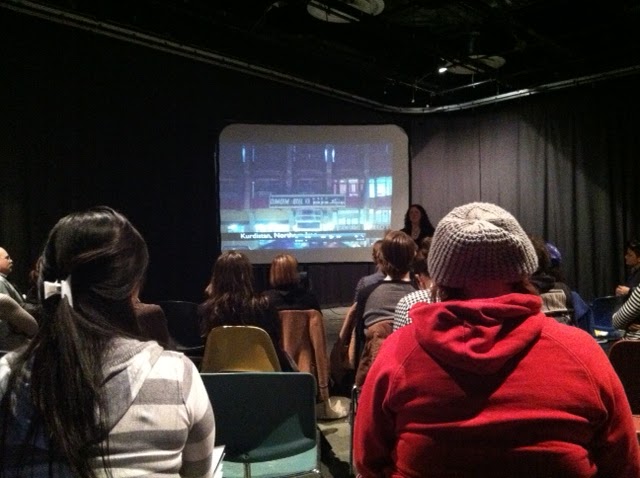 The transition to democracy, however, was not as envisioned by the United States, and Poitras provides a clearer portrayal of the difficulties (physical and emotional) through the very intimate stories of local families, military, and politicians. The friction between US military as well as Iraqi militants paints a disturbingly frightening picture when situated in the midst of threatened locals, who are confronted with the issue of whether or not their lives are worth the vote. My Country, My Country takes us through the journey of all facets of the Occupation - from the black market gun trade financed by the United Nations, to the intimate portrayal of the struggles one family faces, to the portrait of one important man faced with the most extraordinary decision of his and his country's life.
 Thursday, March 17, 2011
The Land of the Not So Great Wall
 I arrived in Beijing not with hopes of finding the evolution of mass media, but at the very least, I expected to find some freedom, as trivial as it may be, in the exchange of discourse, both political and artistic, in media outlets such as television, internet, and perhaps even in public spheres such as Tiananmen Square. I remembered watching then, and reading about the student protests at Tiananmen Square in 1989. As a child, I hadn’t the slightest clue the important and tragic event that was about to unfold. The Chinese government-controlled media outlets reported an unreliable slew of statistics, with deaths of protestors ranging anywhere from under 100 to as many as a few thousand. To this day, the world is still unsure of the events that truly happened but forever ingrained in my memory was the “tank man” - a male protestor who stood defiantly in front of a row of military tanks. This fueled my desire to at long last visit the Square and question the locals as to what actually happened.
 I arrived at Tiananmen Square with a local Beijing tour guide, unbeknownst of my intentions. I surveyed the area cautiously and finally found a local photographer who offered tourists a picture in front of the Square for 50 Yuan, or 8 US Dollars. I quickly removed a $50 Yuan bill from my wallet and before a word is uttered, shoved the bill into the photographer’s hand. A click of a button later, he walks up to me and shows me the fresh image he had captured. In my best effort to sound like a local, I asked, in broken Mandarin what happened with the “tanks” and "protestors" in Tienanmen Square in 1989. However, my lack of expression for the words “tank” and "protest" in a language other than English prompted a lightening quick turn of the head from my tour guide, in which she raced over and carefully yanked at my jacket, whispering to me not to talk about tanks, or ANYTHING related to the protests of 1989. The photographer instantly dashed away with the same rapidity that my tour guide had exerted. She then discreetly pointed with her head in the direction of military police and proceeded to explain the different color uniforms and their significance. She begged me to not talk about anything “controversial” or "political" at the square or anywhere where there was police presence. The look in her eyes told me that she had every intention of protecting me, therefore I obliged.
 The rest of my trip was fruitful, however, as I’d managed to capture images of several types of media (advertisements mostly) that may have a correlation to Western influence. I left Tienanmen Square, exhibiting a confused and somewhat foreign feeling of being watched. I’d always been somewhat of a conspiracy theorist about big brother here in the States, but having experienced what I did firsthand in China, I’d had my eyes opened, then, to the sad reality that there exist places in other parts of the world that place little to no value on the basic human right of freedom of speech.


Thursday, March 10, 2011


Subscribe to:
Posts (Atom)